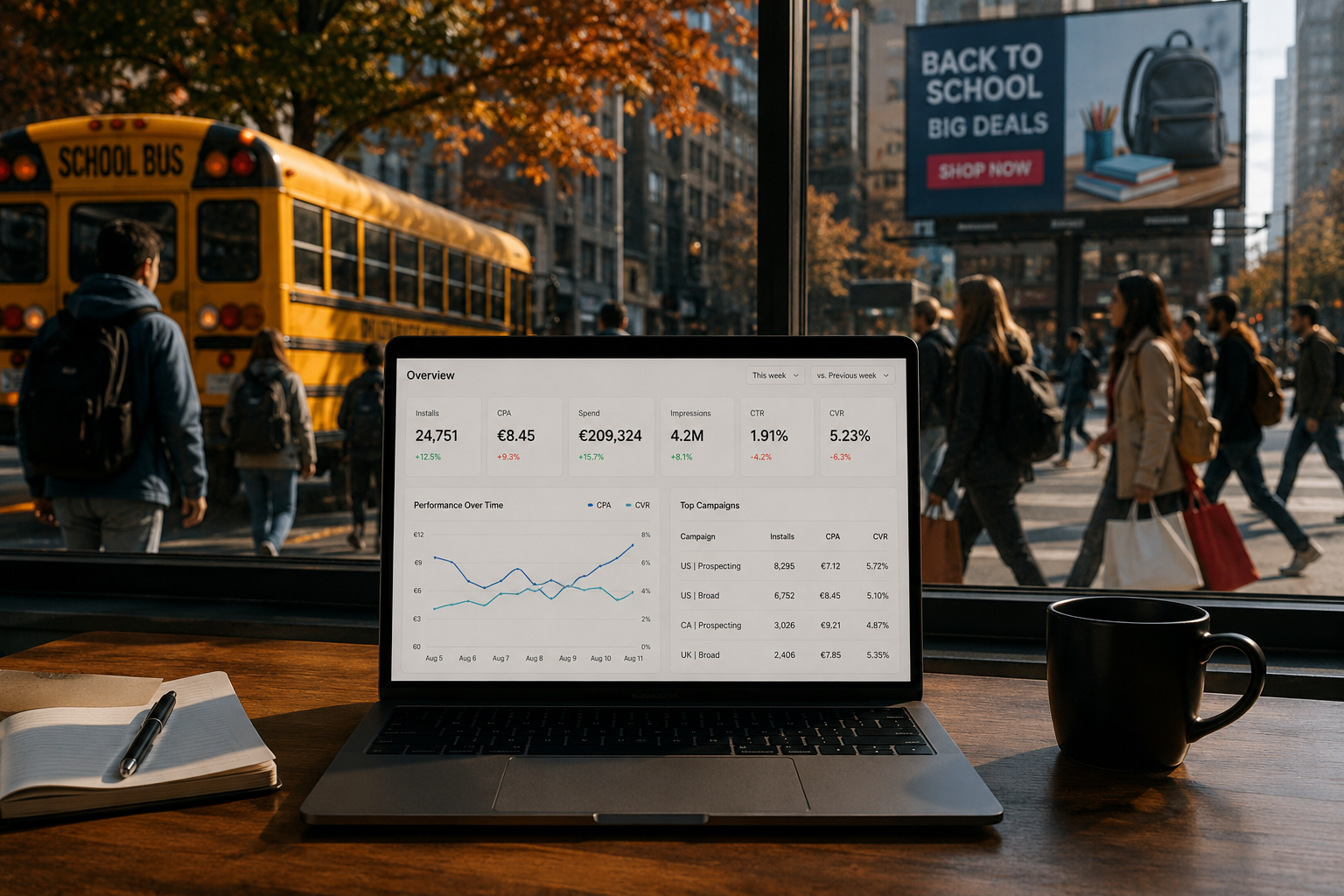
Back-to-School is one of the most anticipated moments in the marketing calendar. For app advertisers, it brings a surge in consumer demand and an opportunity to reach users when purchase intent is naturally higher. Campaigns are planned well in advance, budgets increase, new creatives go live, and acquisition strategies are refined before the season begins.
Yet, despite all that preparation, Back-to-School has a habit of challenging even the most experienced performance marketing teams.
Campaigns that looked healthy only a few days earlier can begin behaving differently. Acquisition costs rise, conversion rates fluctuate, and efficiency becomes harder to maintain. The immediate reaction is often to focus on the campaign itself. Creative is refreshed, audiences are adjusted, budgets are reallocated, and bidding strategies are revisited in an effort to recover performance as quickly as possible.
Those actions are all reasonable. The question is whether they're responding to the actual cause of the change.
One of the reasons Back-to-School is such a useful period for performance teams is that it exposes how much campaign performance depends on the market surrounding it. Competition increases, user behaviour shifts and auction dynamics change over a relatively short period of time, making patterns that are harder to spot during quieter periods much easier to recognise.
Every campaign exists inside a market that's constantly changing, influenced by competitors, consumer behaviour, inventory availability and auction dynamics. Throughout most of the year, those changes happen gradually enough that optimisation processes can comfortably keep pace.
During Back-to-School, many of those changes begin happening simultaneously. Budgets increase, more advertisers compete for the same audiences, auction dynamics shift, and consumer priorities continue evolving throughout the buying cycle. A campaign may remain exactly the same, while the market it's competing in changes considerably over the course of a few days.
That has an important consequence. Performance should no longer be judged against the same expectations that existed before the market changed.
A CPA that looked expensive in August may be entirely reasonable once competition increases across the auction in September. Likewise, a lower click-through rate doesn't automatically suggest creative fatigue if users are suddenly exposed to significantly more advertising than they were a week earlier.
As the market changes, the benchmark for campaign performance changes with it.

When performance starts moving, campaign metrics provide the first indication that something has changed. Arising CPA, lower conversion rate or declining click-through rate immediately attracts attention because those are the metrics marketers are responsible for improving.
What those metrics don't explain is why performance changed in the first place.
A higher CPA might indicate that creative is beginning to fatigue. It might also reflect increased auction pressure as more advertisers compete for the same audience. Lower conversion rates may point towards friction in the user journey, or they may simply reflect changing purchase behaviour as consumers compare products before making a purchase.
Viewed in isolation, those situations can look remarkably similar. Viewed within the context of the market, they often require completely different decisions.
That's where seasonal campaigns become genuinely useful. They force teams to separate symptoms from causes. Instead of immediately asking how to optimise a campaign, they encourage a more fundamental question: what actually changed?
The answer isn't always found inside the campaign itself.
Back-to-School places optimisation processes under pressure in a way that few other seasonal periods do.
When market conditions remain relatively stable, almost every optimisation process appears effective. Teams have time to review reports, investigate performance changes, discuss possible actions and gradually implement improvements before conditions shift again. During Back-to-School, that process becomes more demanding because the market continues evolving while those decisions are being made.
Competition continues changing while campaigns are being analysed. New advertisers enter the market, budgets shift, and consumer behaviour evolves throughout the buying cycle. Every optimisation decision is made against an environment that continues evolving while teams are still deciding how to respond.
That's why Back-to-School acts as a stress test. It highlights whether an optimisation process is built around understanding how the market is changing or simply reacting to changes once they appear in campaign metrics.
It's a subtle distinction, but one that becomes increasingly important as campaigns scale and market conditions become more dynamic.

Across the campaigns we manage, one pattern shows up repeatedly during seasonal periods. The teams that handle shifting market conditions best don't necessarily make more optimisation changes. They spend more time understanding whether what they're seeing is specific to their campaign or reflects a broader change across the market.
That distinction shapes every decision that follows. Two campaigns can show the same increase in CPA for completely different reasons. Treating them the same often creates more work than value.
One example we see regularly during seasonal periods is acquisition costs increasing and the immediate assumption being that creative fatigue is to blame. Sometimes refreshing creative improves performance straight away. Other times it has very little impact because higher acquisition costs are being driven by increased competition across the auction rather than the creative itself.
Campaign data is rarely the missing piece. The real challenge is understanding whether changes in performance reflect the campaign itself or the market around it.
That's harder than it sounds because the market doesn't slow down while those decisions are being made. During high-intent periods like Back-to-School, conditions can shift throughout the day. New competitors enter auctions, budgets move, and consumer behaviour evolves while teams are still reviewing yesterday's performance. The longer it takes to understand what changed, the greater the chance that decisions are being made against conditions that no longer exist.
That thinking also shapes how we've built DrebbelIQ. As campaigns run, it continuously analyses performance, audience and market signals to help our teams identify meaningful changes as they happen. Built on billions of impressions across the open ecosystem, it helps us understand where budgets are likely to create the greatest long-term value and adapt more quickly as market conditions evolve.
Back-to-School is often treated as a seasonal challenge, but the patterns it exposes extend far beyond September.
Markets are constantly evolving. Competition changes, consumer behaviour shifts, and the conditions surrounding a campaign rarely stay the same for long. Back-to-School makes those patterns much easier to recognise.
That's what makes the season such a valuable test for performance teams.
When market conditions evolve over the course of days instead of weeks, every optimisation process is placed under pressure. Teams have less time to understand what's changing, separate temporary fluctuations from meaningful shifts, and decide whether action is actually required.
The same principle applies long after the season ends.
Whether it's Black Friday, a product launch, or an unexpected shift in consumer behaviour, campaigns will continue operating in markets that evolve independently of the campaigns themselves.
Back-to-School simply makes it easier to see why understanding those changes matters.
That's the perspective we bring to every campaign we manage, during Back-to-School and throughout the rest of the year.