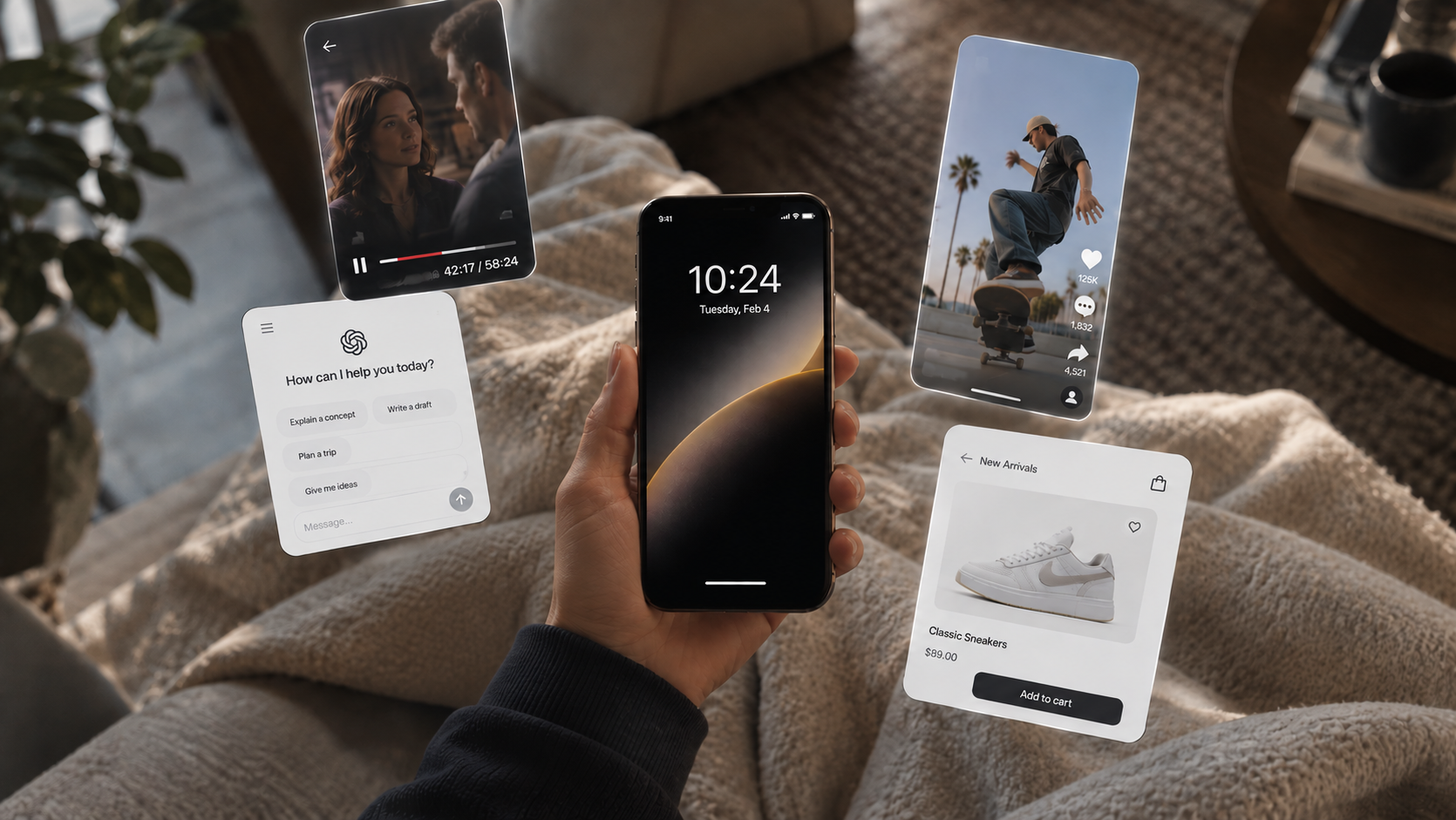
When we think about competition, we tend to look within a category. A streaming app watches other streaming apps. A game looks at other games. A shopping app keeps an eye on other shopping apps.
From a product perspective, that makes sense. But users don't necessarily think in categories when deciding what to do next.
Give someone ten free minutes and they might watch an episode, scroll through TikTok, play a game, browse a shopping app or open an AI assistant. These apps may have very little in common, but in that moment, they're all competing for the same thing: the user's attention.
And the places capturing that attention are changing quickly.
For mobile app user acquisition teams, that makes the competitive picture much bigger than the list of apps offering a similar product.
Mobile users spent 5.3 trillion hours in apps in 2025, up 3.8% year over year. That works out to roughly 3.6 hours per user per day. At the same time, the average number of apps used per person grew to 34 per month.
Within that enormous pool of time, some categories are gaining ground remarkably quickly. AI assistants entered the top 10 app subgenres by time spent in 2025, growing 426% year over year, with ChatGPT leading the category.
Other formats are seeing similar momentum. Paid installs for short-drama subscription apps increased 155% year over year, with paid acquisition now accounting for more than 60% of installs in the category.
The wider app market continues to grow too. Global app installs rose 13%year over year in the first half of 2026, while sessions increased 5%.
Taken together, the picture is one of a very active mobile market where new categories and formats can claim a meaningful share of users' time quickly. For acquisition teams, that expands the competitive landscape well beyond apps offering the same product.
There are two useful layers to that competitive landscape.
Product competition covers the apps offering a similar solution to yours. These are the competitors most teams already track closely through their positioning, pricing, features, creative and acquisition activity.
Attention competition includes the other experiences competing for the time your audience could spend with your app.
For a streaming service, another streaming platform sits in the first group. TikTok, a mobile game or an AI assistant could sit in the second. They solve different needs, but they can still occupy the same ten minutes in someone's day.
That distinction matters particularly in acquisition because the user hasn't always decided what category they want when a campaign reaches them. Competitor analysis that stops at the edge of an App Store category can therefore miss a significant part of the environment in which that campaign has to perform.

Bringing attention competition into the picture adds useful context to decisions UA teams are already making around benchmarking, creative and channels.
Traditional competitor research remains valuable, but it can be supplemented with a closer look at audience behavior.
Changes in where users spend time, the formats gaining traction and the experiences becoming part of their routines can all reshape the competitive picture for acquisition teams. The rapid rise of AI assistants and short-form drama shows how quickly those shifts can happen.
One practical signal is to track time-spent shifts in adjacent categories alongside the install and category rankings you already monitor. An app or category seeing a significant increase in time spent can reveal a change in behavior that download rankings alone may not capture.
The same fragmentation is visible across the wider advertising landscape, as audiences move across search, conversational AI, commerce platforms, social and other discovery environments. Advertisers are responding with greater emphasis on areas including creator partnerships, cohort targeting, first-party data and contextual advertising.
The competitive context changes once an ad reaches the screen.
Take a streaming ad appearing between short-form videos. The surrounding content was something the user actively chose to consume, and that sets a different bar for the creative than a side-by-side comparison with other streaming ads.
Value needs to become clear quickly, while the hook, proposition and format need to make sense in that specific environment. A creative can look distinctive within its category and still struggle when placed next to content that already has the user's attention.
That points to a different benchmark. Placement-level signals such as hook rate and watch-through can show how well the creative holds attention in the environment where it actually appears. For a streaming ad in a short-form feed, that means competing with the next fifteen seconds of native content as much as with creative from another streaming service.
Looking at creative this way shifts the benchmark closer to the actual experience of the person seeing the campaign.
User behavior also has implications for channel strategy.
The acquisition landscape now spans in-app environments, mobile and desktop web, CTV, PC games and consoles, creating more room for teams to diversify their acquisition channels.
As those opportunities evolve, past channel performance becomes one input rather than a fixed map of where future growth will come from.
New environments can be approached as structured tests, with a capped budget, a defined timeframe and success criteria set before launch. Alongside acquisition cost, an appropriate early retention or LTV signal can help show whether the environment is producing users with downstream value.
Strong install-level performance can make a new environment look promising early on, so keeping downstream quality in the evaluation helps determine whether it deserves further investment.

A platform or format gaining attention can be worth investigating without automatically deserving more budget. The opportunity can also look very different depending on the market.
Short drama is a good example. While the category has seen rapid growth, that growth isn't uniform. Downloads more than doubled year over year across several markets, while consumer spend in North America declined 40%.
For UA teams, shifts like these can point to where new opportunities are developing. Performance determines whether those opportunities are worth pursuing.
This adds a third layer to the competitive picture:
· Product competition shows who else can meet a similar need.
· Attention competition shows what else is competing for the user's time.
· Performance data shows where winning that time creates value.
Audience behavior, creative performance and channel opportunities rarely change at the same pace. That leaves UA teams working with a competitive picture that can look different from one campaign, audience or market to the next.
Making sense of those changes depends on how quickly useful signals can be identified and translated into campaign decisions.
At Creative Clicks, DrebbelIQ continuously analyzes campaign signals as they come in and makes adjustments while campaigns are running. That allows performance decisions to respond to what is happening across placements, creative and audiences rather than relying solely on assumptions made at the start of a campaign.
That shortens the gap between seeing a change in performance and acting on it.
Category competitors will always matter. They show how similar products are positioned and the alternatives available to someone already considering your category.
Attention competition adds the wider context: everything else competing for that person's time before they ever reach that choice.
Product competition. Attention competition. Performance.
Together, they offer a more complete view of what you're really competing against when acquiring your next user.